trading3d
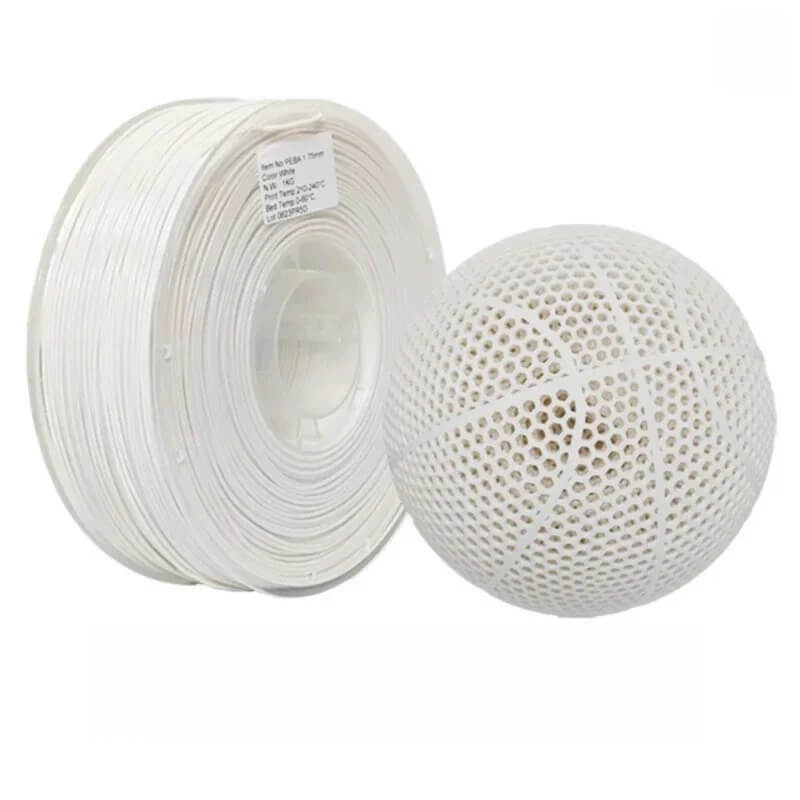
Beyond TPU! High-Performance PEBA Flexible Filament for 3D Printed Sports Gear Higher Rebound & Stronger Support 1.75mm
Beyond TPU! High-Performance PEBA Flexible Filament for 3D Printed Sports Gear Higher Rebound & Stronger Support 1.75mm
Couldn't load pickup availability
✔ Ships from China Warehouse via Global Special Line
✔ Tracking provided for all orders
✔ Free Global Shipping on orders over $99
✔ Standard delivery time: 7–12 business days (US/EU)
Redefining Elasticity! PEBA — The Ultimate High-Performance Flexible Filament Beyond TPU
When your project demands the ultimate in elasticity, lightweight properties, and durability, traditional TPU has reached its limit. Experience PEBA – the game-changer in elastic 3D printing. With its higher rebound rate, exceptional energy return, and incredible lightness, it's the ideal choice for printing professional-grade sports equipment, functional insoles, and custom medical devices. Let your designs not just bend, but bounce back with vigor.
3D-printed shoes
Honeycomb-patterned hollow-moulded construction delivers both breathability and abrasion resistance. Superior impact resistance compared to TPU effectively absorbs forces during movement. With elastic recovery exceeding 85%, it reduces exercise fatigue and is commonly employed in running shoe midsoles.
3D Printed Bicycle Saddle
PEBA exhibits exceptional high resilience, effectively absorbing road vibrations during cycling to reduce pressure concentration on the ischial tuberosities. While lightweight, it also possesses considerable abrasion resistance and weather resistance, capable of withstanding dynamic loads encountered during cycling to prevent fracture or deformation.
3D Printed Pet Interactive Ball
Lightweight design with 15% to 20% lower density than TPU. PEBA balls are lighter for the same volume, exceptionally bite-resistant and tear-resistant, matching injection-moulded quality, and maintain shape over prolonged use.
3D Printed Basketball
The PEBA-printed basketball exhibits outstanding elasticity and cushioning properties, enabling rapid rebound upon landing. Its excellent abrasion resistance and tear strength effectively withstand surface wear and internal structural damage.


Why is PEBA the Upgrade Over TPU?
Exceptional Energy Return: Features a rebound rate far exceeding standard TPU, effectively absorbing and releasing impact energy. Printed products like basketballs and insoles provide superior cushioning and responsiveness.
Strong Support & Toughness: Maintains flexibility while offering higher tensile strength (43MPa) and impact resistance. Printed parts are resistant to permanent deformation and offer excellent durability.
Extreme Lightweight: With a density as low as 1.0g/cm³, it's the perfect partner for lightweight design. Printed sports gear feels comfortable to wear with no sense of burden.
Smooth Printing Experience: Compared to TPU, its melt flow stability is superior, effectively reducing clogging risks. Achieve higher success rates even with Bowden tube printers.
Professional Grade Applications: From high-performance shoe midsoles to customized medical orthotics, PEBA meets the most advanced functional printing needs, elevating your creations to a professional level.
Product Specifications & Printing Guide
| Material | PEBA (Polyether Block Amide) |
| Diameter | 1.75mm (±0.05mm) |
| Density | 1.0g/cm³ |
| Tensile Strength | 43 MPa |
| Nozzle Temperature | 210 - 240°C |
| Build Plate Temperature | 0 - 60°C (Recommendation: Use painter's tape or glue stick, good adhesion can be achieved at 20-40°C) |
| Print Speed | Recommend 20-40 mm/s (Adjustable based on printer capability) |
Professional Application Fields
PEBA is revolutionizing customization manufacturing in the following areas:
Athletic Footwear: 3D printed midsoles and insoles for high-performance running shoes, basketball shoes.
Sports Equipment: Basketballs, bicycle saddles, sports protectors, helmet liners.
Medical Field: Custom orthopedic insoles, prosthetic sockets with excellent cushioning, rehabilitation equipment handles.
Industrial Prototyping: Seals, damping pads, flexible jigs requiring high rebound and fatigue resistance.
Tips for Successful Printing
Drying: PEBA is hygroscopic. It is highly recommended to dry at 65-70°C for 4-6 hours before printing to completely avoid bubbling and stringing.
Print Slow: Flexible materials are not suitable for high-speed printing. Start at 30mm/s and gradually test and optimize.
Disable Feeder Gear: Ensure the feeder gear is not too tight during printing to avoid deep marks on the filament, which can cause feeding inaccuracies.
Enable Retraction: Using moderate retraction settings is recommended to effectively reduce stringing.
Frequently Asked Questions
Q: What exactly is the difference between PEBA and TPU?
A: Think of it as a "high-performance upgrade" to TPU. PEBA surpasses TPU in rebound rate, toughness, lightweightness, and low-temperature impact resistance, offering a more stable printing experience, albeit at a higher cost.
Q: Can I use it with my entry-level FDM printer?
A: Yes! PEBA's printing temperature is even lower than some TPUs, and it flows well. As long as your printer has an all-metal hotend capable of reaching around 220°C stably, and has a smooth filament path (like PTFE tube), you can try it. Printers with direct drives will perform best.
Q: Can the printed basketballs actually be used for playing?
A: Absolutely! A PEBA basketball printed with 100% infill possesses excellent elasticity and durability, making it perfectly suitable for actual play. You can adjust the infill density to fine-tune its hardness and weight as needed.
Explore the Limits of Performance
We are committed to providing you with the most cutting-edge 3D printing materials. This PEBA filament represents the pinnacle of flexible material technology, helping you turn your boldest ideas into reality. Experience it now and feel the difference that professional-grade performance makes.